| Trinity Presbyterian Church 1400 Sheley Road Independence, MO 64052 |
The Family We Call Trinity
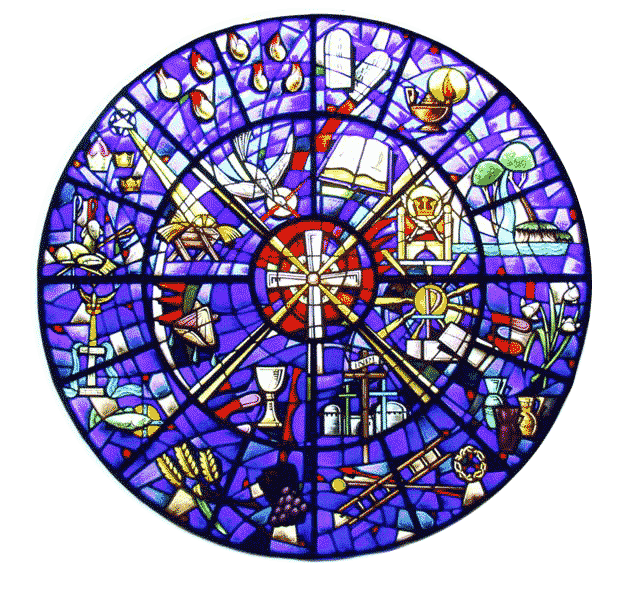
| Sanctuary Stained-Glass Window |
| The Story of Trinity Presbyterian Church, USA |
Members of First Presbyterian Church of Independence, Missouri, saw a need for another church in
1952. To meet this need they formed a group to establish which eventually we now know as Trinity
Presbyterian Church. It, too, is in Independence.
While combining their own blood, sweat, tears and love with the efforts of professional contractors,
the membership saw the church building rise from the ground to become the building with the large
front columns you now see.
Services began before the main building was fully completed.
Soon after, membership growth made it necessary to add a wing to the building to meet the demands
for more classrooms and facilities for the growing congregation.
In 1981 Trinity again faced the challenge of a growing membership with too little room. Banding
together once again, a new sanctuary was constructed and additional modern amenities were added
to assure the facilities met the needs of a growing body of Christ.
The previous sanctuary, which is on the top floor of the first building, became Founder's Hall and is
now a favorite place for large meetings, honor luncheons, special services, dinners and even adult
Sunday education classes.
In 2000 Trinity added an elevator, enlarged the parking lot in back of the church, remodeled
Founder's Hall and added a small kitchenette to compliment the large kitchen found in Fellowship
Hall on the lower level.
Like the building, Trinity's parishioners and its mission have gone through many changes. In 2001
the members of Westminster Presbyterian Church, Independence, joined the Trinity congregation.
The move brought many wonderful new faces and gifts, as well as new traditions.
The current membership is representative of all ages. They come from the immediate area, Kansas
City, Raytown, and even as far away as Lee's Summit, Blue Springs and Oak Grove. Average
worship attendance is 79 and we worship in a style that blends both traditional and contemporary
perspectives. The Rev. Elizabeth Strobel is serving as pastor.
1952. To meet this need they formed a group to establish which eventually we now know as Trinity
Presbyterian Church. It, too, is in Independence.
While combining their own blood, sweat, tears and love with the efforts of professional contractors,
the membership saw the church building rise from the ground to become the building with the large
front columns you now see.
Services began before the main building was fully completed.
Soon after, membership growth made it necessary to add a wing to the building to meet the demands
for more classrooms and facilities for the growing congregation.
In 1981 Trinity again faced the challenge of a growing membership with too little room. Banding
together once again, a new sanctuary was constructed and additional modern amenities were added
to assure the facilities met the needs of a growing body of Christ.
The previous sanctuary, which is on the top floor of the first building, became Founder's Hall and is
now a favorite place for large meetings, honor luncheons, special services, dinners and even adult
Sunday education classes.
In 2000 Trinity added an elevator, enlarged the parking lot in back of the church, remodeled
Founder's Hall and added a small kitchenette to compliment the large kitchen found in Fellowship
Hall on the lower level.
Like the building, Trinity's parishioners and its mission have gone through many changes. In 2001
the members of Westminster Presbyterian Church, Independence, joined the Trinity congregation.
The move brought many wonderful new faces and gifts, as well as new traditions.
The current membership is representative of all ages. They come from the immediate area, Kansas
City, Raytown, and even as far away as Lee's Summit, Blue Springs and Oak Grove. Average
worship attendance is 79 and we worship in a style that blends both traditional and contemporary
perspectives. The Rev. Elizabeth Strobel is serving as pastor.
Sunday, for many of us, is the highlight of our week because of the caring and acceptance we feel
within the church community, and we are eager to share the good news of Jesus with others.
Find hope here.
We, the members of the Trinity Presbyterian Church, being covenanted with the living God, through
Jesus Christ, and being His people in this place and in this age, do sincerely and openly make this
covenant with one another. We strive to provide the following as a Church Family and mission:
Weekly celebration in worship of the Living God as He comes to us through Jesus Christ; An
on-going nurture in the acceptance and caring of one another; A deepening awareness through
education of what our Christian faith means to us; Participating in a witnessing love which declares to
the world the love of God in Jesus Christ and an invitation to be part of it; Opportunity to seek out
and work for those means of pursuing the justice of God in the wholeness of life.
We as individual members covenant to use the gifts God has given us:
To be regular in worship and to grow in peace and Christian knowledge; To draw others to the
Church and to promote a spirit of love within the Church; To be supportive of the ministers of the
Church and to support the Church financially; And to be loyal to the Church and to give evidence of
the power of Christ by a Christ-like life.
within the church community, and we are eager to share the good news of Jesus with others.
Find hope here.
We, the members of the Trinity Presbyterian Church, being covenanted with the living God, through
Jesus Christ, and being His people in this place and in this age, do sincerely and openly make this
covenant with one another. We strive to provide the following as a Church Family and mission:
Weekly celebration in worship of the Living God as He comes to us through Jesus Christ; An
on-going nurture in the acceptance and caring of one another; A deepening awareness through
education of what our Christian faith means to us; Participating in a witnessing love which declares to
the world the love of God in Jesus Christ and an invitation to be part of it; Opportunity to seek out
and work for those means of pursuing the justice of God in the wholeness of life.
We as individual members covenant to use the gifts God has given us:
To be regular in worship and to grow in peace and Christian knowledge; To draw others to the
Church and to promote a spirit of love within the Church; To be supportive of the ministers of the
Church and to support the Church financially; And to be loyal to the Church and to give evidence of
the power of Christ by a Christ-like life.
The following is from an issue of the Kansas City Star dated April 20, 1957. It gives many details on
how a Celtic cross was made and installed in the front the church by some youth of the church. The
present cross gracing the front of the church is the third one installed in 2004 because weather got to
the first and second crosses.
The Star head line was: “Youth with Long Hours of Devoted Labor Give Their Church Celtic Cross
at Easter.” We quote it below.
"When in the dusk of last Wednesday evening some 10 men, with perhaps another 60 looking on, had
completed the erection of the 900 pounds of the Celtic Cross on the Grounds of the Trinity
Presbyterian Church out in the southwest marshes of town, a sudden quiet came to those gathered
there, and some removed their hats in the reverence of a strangeness that came upon them.
"For this was no ordinary cross, this Celtic Cross. Hovering over it, like an unseen tenant, and
protecting it, were an historical legion reaching back now only to the very beginnings of the
presbyters of Old Scotland in the time of Mary Queen of Scots, when with John Knox all Scotsmen
effected their own splintering off from the Lutheran Reformation; but, on further back to 635 A.D., a
Millennium before: in the time of King Oswald of North Umbria; in the earliest beginnings of
Christianity beyond the Roman Empire; in the savage turbulence of the Northlands.
"For this cross, of which the one here is a highly altered imitation, translated dimly and imperfectly
the mutations of the old pagan rites and divinings of the Druids into the modes of the Christian
inspiration.
"It had at first been created by refugees from religious persecution from the hills of Scotland, who
had fled to the Island of Iona off the wild northwest coast of Ireland; but, though they had become
Christian in their professings, they retained still the deep roots of the Druidic rites and ratiocinations
of their tribal fathers. And these were all fused into the symbols they carved half-magically into their
cross.
"When Scot missionaries of the time of Mary Queen of Scots discovered this cross, it became
embosomed at once as the standard of the infant Presbyterian Church of Scotland.
"Thus it was in the dusk of last Wednesday evening these man stood hushed, though few perhaps
were aware of the full history of what they had raised there, and so shuffled uneasily as they turn to
the Rev. Oscar Gustafson, to say in low, uncertain voices that it seemed, did it not? A prayer should
be said? And this the Rev. Gustafson did.
"In the days following, and at night when the moon escaped from the thunder heads, many stopped to
stare in wonderment. It reared like an apparition, to some stark, to others eerie, out of another
world, or reminding the present of ancient mists, long vanished, when long-forgotten figures strove,
and perhaps failed, but yet worshiped according to the lights of their Eternity. This they had to
create for themselves, as all men have had to before them and since with their own thinking.
"In the night wandering squad cars of the police, seeing the people standing and staring in the
moonlight, pulled up short and trained a light on this strange thing, and marveled as the rest, and
somewhat perhaps as the shepherds when the Star of Bethlehem burst full upon them, in the old tale.
"It stood high, huge in it sentinel solitude 16 feet above the earth, with its spreading arms and the
great Druidic circle symbolizing the eternality that embraces in its never-endingness both death and
life.
"Work of Teenagers. An apparition, perhaps, to the unwary coming upon it, but no happenstance.
Inside it is a copper scroll, and on it are engraved these names of the young people, all teenagers, of
the Trinity Presbyterian Church. Girls, first, they are: Gene Ann Baade, Katherine Lent, Nancy
Brown, Judith Hokum, Linda Smith, and Janet Scribe. The boys: Jimmy McConchie, Jr., Jon
Morris, Micky Morris, Dickey Morris, Dave Lyons, Ronnie Dollins, Jimmy Lewis, Bob
Wennersten, and Bob Edwards.
"They were the young people who made the Celtic Cross, who gathered in long sessions through the
dark hours of winter, bringing wood from their garages and basements to the church parlor and sitting
before the roaring fireplace to carve out of two-by-four yellow pines the symbols of their Celtic
Cross. For it was imperative that it stand where it is, on a spot that in the chancel of future buildings
will be the site of the altar, to stand high in the resurrection of life that is Easter.
"This Cross cost nothing but the labor of these. There are 154 pieces of wood in the cross, and these
young people brought it from their own homes or wherever they could find it.
"They SCROUNGED them. They scrounged everything else. They scrounged the nails, the
screws, the two electric routing machines and the 16 cutting bits of different sizes to rough out for the
wood chisels.
"Use Electric Routers. Only two were allowed to use the two electric routers, for machines that spin
diamond-hard cutters at 22,000 revolutions per minute are dangerous, and are not playthings. The
skilled ones here were Dave Lyons, 18, son of Mr. And Mrs. Carl Lyons, 2904 S. Forest, and Micky
Morris, 15, son of Mr. And Mrs. Vern Morris, 1203 W. Bryson. Mickey was also the official an
indefatigable scrounger, and implacably a producer, so they all declare together. Whatever they
needed, he got.
"But these could not have routed, nor the rest, the carvers, have carved with their chisels and
knives, without first the artistry of Janet Scribner, the 17-year-old daughter of Mr. And Mrs. Sam
Scribner, 1313 W. 29th Terrace. Janet drew carefully on the exterior woods the designs of the
symbols to be executed, and eliminated the more minuscule lines intolerable to their engraving tools.
"Now, there were adults in this, but in a functions strictly auxiliary and little of that. A too man kept
the tools dangerously sharp for the delicate carving of the carvers, who made experts of themselves
by studying an art which, in the beginning of late last summer, they had thought of nothing at all.
"Guard Against Termites. Then there were the Bell Pest Control people, none of them of the church,
who contributed three gallons of termite chemicals to saturate the lower feet of the shaft of the cross,
and four feet of earth into which the cross had been sunk. And there was a workaday painter, Jess
Hauptley, who gave these workers a wood preservative to apply with the linseed oil coatings. But
these young ones did all the work, until a few were spending more time at the cross they were
building than they were in their school studies at home, especially as the deadline, which was Easter,
thrummed in their minds with its nearness.
"But far back they had to determine their symbols. Some of the old Druidic symbols were discarded,
but not all, with 45 Christian symbols given substitution. Thus the labyrinths of the original cross of
the Island of Iona, by which the artist of the Druids felt life’s entanglements were inextricably man’s
fate, to be accepted with equanimity, have been largely replaced by the gridirons on which early
Christians were sometimes roasted alive by their persecutors. But the old pagan concept of
eternality as described by a great circle, from which the immutable tie of the simple wedding ring was
derived, is retained. Instead of the lines of medieval Gothic spires pointing towards Eternity,
supported by the buttressing earth. Here, too, the flaying knives of Bartholomew, “the silent
apostle,” tho word of whose was ever recorded.
"Flame of the Pentecost. Along the south shaft is the seven-tongued flame of the Pentecost; the
Savior as the light of the world; the star or Bethlehem; a flaring head of wheat for growth; the
carpenter’s square and a spear for all who work with their hands.
"Of the pagan concept, however, there is retained the bursting pomegranate seeds of prolification,
and the opening flower which the Druids sometimes wove into their Great Circle of the unassailable
eternal to denote, as one symbol among thousands of primitive men, the aggressions of fertility.
"But, the center of the big circle is a smaller, and in its center a ship on the waves. And this has
been adopted for its symbol by the World Council of Churches.
"There is much more on the Celtic Cross. But to detail all its features is surely to violate the
privacy of its strength. These cannot in any case be seen as the cross stands starkly alone in the
moonlight, poised quiet and solitary and brooding in the spirit of its contained knowledge, as scret to
the view as the unseen copper scroll with the names of 14 boys and girls inside it. Not mere
autographs these names, but signatory to the spirit that moved them at their labor through the black
winter hours, also in the words: “Created by the youth of Trinity Presbyterian Church to the glory of
God. A church is only built by those who are willing to work”...........(here several words are missing
from our copy of the article)....... 'no other hands than our.'”
The article ended at this point
For several years the Celtic Cross stood as a welcomed landmark for Trinity Presbyterian.
However, time and the elements slowly changed and the cross became in need of repair. So, church
member Gary Elting, an experienced craftsman, stepped forward and offered to make another cross
exactly like the one the youth had so lovingly made in 1957.
Gary completed the new Celtic Cross in 1973 and it was installed. This time it was not placed in the
ground but upon a concrete base. Again in 2004 Gary stepped forward and with his talents the cross
of replicated and reinstalled and now stands in front of the church.
Gary also crafted a smaller replica and it hangs in the sanctuary. A picture of it serves as the cross
in the background pages of this website.



 |
 |
 |
 |
 |
 |
 |
 |
 |
 |
 |
 |
| We are a people who serve the Lord Jesus Christ with our hearts, our minds and our hands. We ask questions, we find answers, support, challenge, and fellowship in our church family. We believe we are called to serve the world, our community, and one another with Christ-like love. We live in hope and with joy, because by God's grace we have been forgiven. |